Dr. Overy's KBase: Resources for Teaching and Learning

New Mexico: The Very Large Array

Article ID: 6
Last updated: 15 Dec, 2023

Consisting of an array of 27 antenna, the Very Large Array (VLA) is one of the most powerful radio telescope systems in the world... (All photos were taken by Dr Martyn Overy )

vla1

( Photo credit : M.J. Overy)

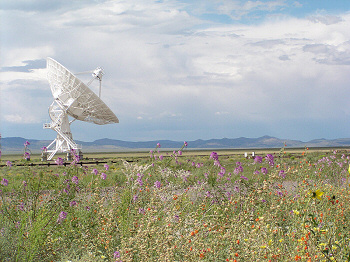
Twenty seven of these dish-shaped antenna are used in the array.  The signals from each antenna are combined, using wave guides and powerful computer systems to give high resolution images of distant objects. Each antenna has a dish of 25 metres diameter and weighs 230 tons. 

vla2

( Photo credit : M.J. Overy)

The VLA receives radio waves in the wavelength range between 0.7 cm to 400 cm. The combined signals of the antenna gives the equivalent resolution and detail that would be obtained from a single antenna of 36 km in diameter!

vla3

( Photo credit : M.J. Overy)

Astronomers from around the world use this VLA o­n a continuous basis, using a number of projects which are dependent o­n a given configuration of the array.  Stars, planets, galaxies,comets and distant gas clouds are just some of the celestial objects which have been studied in detail with the VLA. 


( Photo credit : M.J. Overy)

At a height of over 7000 feet the VLA is located miles from cities and towns which would give interference problems with the reception of the weak radio waves from distant parts of the Universe.  Visitors are not allowed to operate mobile phones near the VLA for the same reason. 


( Photo credit : M.J. Overy)


Large separations of the antenna are used when astronomers need to examine smaller regions of the sky in more detail. Smaller separations of the antenna provide a greater area of the sky to be examined. This moveable system acts in a similar way to a 'zoom lens' facility o­n a camera.


( Photo credit : M.J. Overy)

The antenna can be spread across 26 miles of New Mexico's Plains of San Agustin. The separation of the antenna can be varied very precisely using computer controlled systems. The antenna move along specially designed rail tracks. 


( Photo: M.J. Overy)
The receivers inside each antenna are cooled to 15 K ( -427 F) .  This is to reduce any interference from local radio noise, which would otherwise totally mask the weak radio signals from outer space.  The signals are sent underground along specially constructed wave guides. They are then received and processed at the Control Centre. Very powerful computers are used to combine and analyse the images provided by the radio signals


( Photo: M.J. Overy)
 

Article ID: 6
Last updated: 15 Dec, 2023
Revision: 4
Views: 188
print  Print email  Subscribe email  Email to friend share  Share pool  Add to pool
Prev     Next
Beyond our World       Videos